


Page 13 - Demo
P. 13
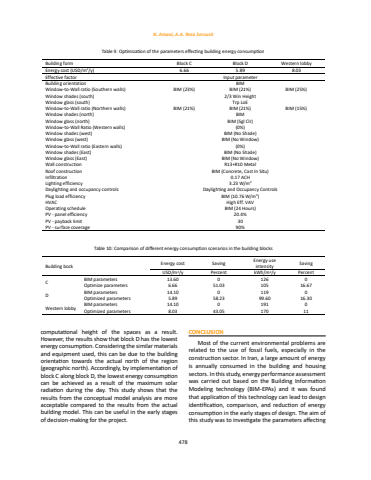
478N. Amani, A.A. Reza Soroushcomputational height of the spaces as a result. However, the results show that block D has the lowest energy consumption. Considering the similar materials and equipment used, this can be due to the building orientation towards the actual north of the region (geographic north). Accordingly, by implementation of block C along block D, the lowest energy consumption can be achieved as a result of the maximum solar radiation during the day. This study shows that the results from the conceptual model analysis are more acceptable compared to the results from the actual building model. This can be useful in the early stages of decision-making for the project. Table 9: Optimization of the parameters effecting building energy consumptionBuilding form Block C Block D Western lobbyEnergy cost (USD/m2/y) 6.66 5.89 8.03Effective factor Input parameterBuilding orientation BIMWindow-to-Wall ratio (Southern walls) BIM (23%) BIM (21%) BIM (25%)Window shades (south) 2/3 Win HeightWindow glass (south) Trp LoEWindow-to-Wall ratio (Northern walls) BIM (21%) BIM (21%) BIM (15%)Window shades (north) BIMWindow glass (north) BIM (Sgl Clr)Window-to-Wall Ratio (Western walls) (0%)Window shades (west) BIM (No Shade)Window glass (west) BIM (No Window)Window-to-Wall ratio (Eastern walls) (0%)Window shades (East) BIM (No Shade)Window glass (East) BIM (No Window)Wall construction R13+R10 MetalRoof construction BIM (Concrete, Cast In Situ)Infiltration 0.17 ACHLighting efficiency 3.23 W/m2Daylighting and occupancy controls Daylighting and Occupancy ControlsPlug load efficiency BIM (10.76 W/m2)HVAC High Eff. VAVOperating schedule BIM (24 Hours)PV - panel efficiency 20.4%PV - payback limit 30PV - surface coverage 90%Table 9: Optimization of the parameters effecting building energy consumptionCONCLUSIONMost of the current environmental problems are related to the use of fossil fuels, especially in the construction sector. In Iran, a large amount of energy is annually consumed in the building and housing sectors. In this study, energy performance assessment was carried out based on the Building Information Modeling technology (BIM-EPAs) and it was found that application of this technology can lead to design identification, comparison, and reduction of energy consumption in the early stages of design. The aim of this study was to investigate the parameters affecting Table 10: Comparison of different energy consumption scenarios in the building blocksBuilding bock Energy cost Saving Energy use intensity SavingUSD/m2/y Percent kWh/m2/y PercentC BIM parameters 13.60 0 126 0Optimize parameters 6.66 51.03 105 16.67D BIM parameters 14.10 0 119 0Optimized parameters 5.89 58.23 99.60 16.30Western lobby BIM parameters 14.10 0 191 0Optimized parameters 8.03 43.05 170 11Table 10: Comparison of different energy consumption scenarios in the building blocks


