


Page 11 - Demo
P. 11
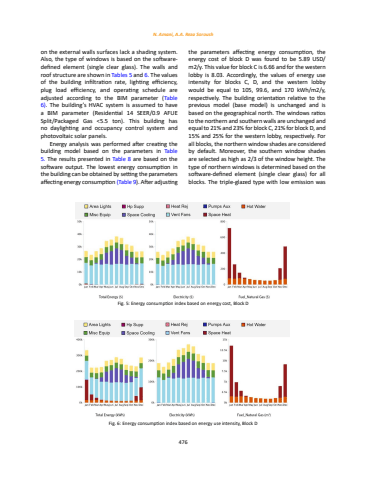
476N. Amani, A.A. Reza Soroushon the external walls surfaces lack a shading system. Also, the type of windows is based on the softwaredefined element (single clear glass). The walls and roof structure are shown in Tables 5 and 6. The values of the building infiltration rate, lighting efficiency, plug load efficiency, and operating schedule are adjusted according to the BIM parameter (Table 6). The building%u2019s HVAC system is assumed to have a BIM parameter (Residential 14 SEER/0.9 AFUE Split/Packaged Gas <5.5 ton). This building has no daylighting and occupancy control system and photovoltaic solar panels.Energy analysis was performed after creating the building model based on the parameters in Table 5. The results presented in Table 8 are based on the software output. The lowest energy consumption in the building can be obtained by setting the parameters affecting energy consumption (Table 9). After adjusting the parameters affecting energy consumption, the energy cost of block D was found to be 5.89 USD/m2/y. This value for block C is 6.66 and for the western lobby is 8.03. Accordingly, the values of energy use intensity for blocks C, D, and the western lobby would be equal to 105, 99.6, and 170 kWh/m2/y, respectively. The building orientation relative to the previous model (base model) is unchanged and is based on the geographical north. The windows ratios to the northern and southern walls are unchanged and equal to 21% and 23% for block C, 21% for block D, and 15% and 25% for the western lobby, respectively. For all blocks, the northern window shades are considered by default. Moreover, the southern window shades are selected as high as 2/3 of the window height. The type of northern windows is determined based on the software-defined element (single clear glass) for all blocks. The triple-glazed type with low emission was Fig. 5: Energy consumption index based on energy cost, Block DFig. 6: Energy consumption index based on energy use intensity, Block DFig. 5: Energy consumption index based on energy cost, Block DFig. 6: Energy consumption index based on energy use intensity, Block D


