


Page 14 - Demo
P. 14
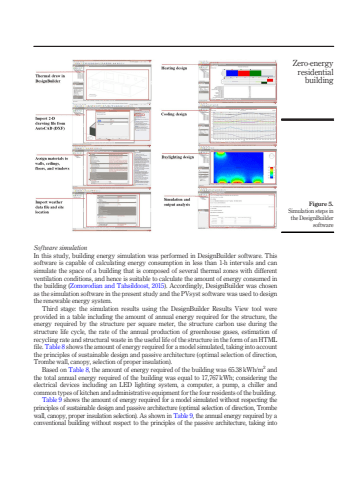
Software simulationIn this study, building energy simulation was performed in DesignBuilder software. Thissoftware is capable of calculating energy consumption in less than 1-h intervals and cansimulate the space of a building that is composed of several thermal zones with differentventilation conditions, and hence is suitable to calculate the amount of energy consumed inthe building (Zomorodian and Tahsildoost, 2015). Accordingly, DesignBuilder was chosenas the simulation software in the present study and the PVsyst software was used to designthe renewable energy system.Third stage: the simulation results using the DesignBuilder Results View tool wereprovided in a table including the amount of annual energy required for the structure, theenergy required by the structure per square meter, the structure carbon use during thestructure life cycle, the rate of the annual production of greenhouse gases, estimation ofrecycling rate and structural waste in the useful life of the structure in the form of an HTMLfile. Table 8 shows the amount of energy required for a model simulated, taking into accountthe principles of sustainable design and passive architecture (optimal selection of direction,Trombe wall, canopy, selection of proper insulation).Based on Table 8, the amount of energy required of the building was 65.38 kWh/m2 andthe total annual energy required of the building was equal to 17,767 kWh; considering theelectrical devices including an LED lighting system, a computer, a pump, a chiller andcommon types of kitchen and administrative equipment for the four residents of the building.Table 9 shows the amount of energy required for a model simulated without respecting theprinciples of sustainable design and passive architecture (optimal selection of direction, Trombewall, canopy, proper insulation selection). As shown in Table 9, the annual energy required by aconventional building without respect to the principles of the passive architecture, taking intoFigure 5.Simulation steps inthe DesignBuildersoftwareZero-energyresidentialbuilding


